
"Net-Neutrality" is Bullshit

September 21, 2007 at 9:16 pm | In Libertarian Rants |

I've passively read all the junk about "Net Neutrality" over the years but I've never publicly made any statement on the subject. I've never felt threatened by what net neutrality pushers claim, that the internet as we know it is going to die if content providers are allowed free reign. I see the internet as being the most free medium of expression in the entire history of the world. Naturally, I don't want my freedom online to be threatened by service providers steering me in one direction or another. I want to go about my online business in whatever manner I choose and I will not allow my service provider to dictate otherwise. However, net neutrality is an improper solution to a non-existent problem.

The people pushing net neutrality assert that, without governmental regulation, greedy corporations providing internet access will force their views (as well as those of their sponsors) down our throats — that, by providing these government regulations, we'll have a more free internet than we do today. I'm sorry, but when has government regulation EVER made anything more free? We can argue about government programs and regulations making things safer, cheaper, more "accessible" (I don't believe any of this for an instant). But, we cannot argue that government regulations will ever make things more free. Government regulations, by definition, make things less free.

I saw this on digg today:
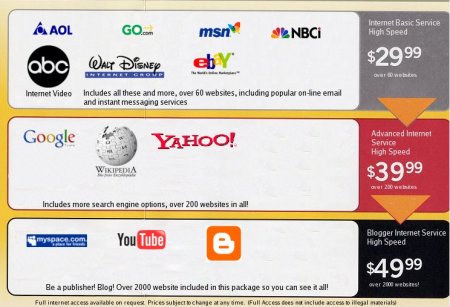
Net Neutrality deceptively shown as a cable company

What we have here is someone saying that unless we push for net neutrality, internet service providers will someday become like cable/satellite TV companies in that they will decide what content you will receive and that they will charge you different prices based on your internet habits. There are many, many problems with this analogy. The most glaring to me is this: the cable companies acquired their monopolistic positions today because of government regulation. So, if we want to make the net more "neutral," we should remove these artificial, government created, monopolies. We shouldn't do the opposite. In a free market I can choose whatever content provider I want. If provider X wants to block my access to Google, well, I'll just choose to go to another provider.

And what's so wrong with a company deciding what kinds of services it will provide to me? What makes American consumers so presumptuous that they think that they can decide how that company will operate? That's like saying "I like pizza. Therefore, McDonald's, you have to start making pizza and you have to charge only $.45 a slice and, if you don't do what I say, I'm going to get my goon squad government to force you to do it."

The argument that internet access is a fundamental right of humans is a massive misunderstanding of what a fundamental right is. Yet, this argument is a major part of the rhetoric of the mainstream democrat/neocon agenda. If you are in disbelief, you don't have to look much further than the website of current presidential hopeful Hillary Clinton:

[The Rural Broadband Initiatives Act] will extend and improve access to broadband services in small towns across America. It creates a policy and action framework to ensure that the federal government employs an effective and comprehensive strategy to deploy broadband service and access in the rural areas of the United States. The bill will also establish a Rural Broadband Innovation fund to explore and develop cutting edge broadband delivery technologies to reach underserved rural areas.

Senator Clinton doesn't come right out and say it, but there are enough keywords to get her drift — that internet access is a fundamental right, that government is the best provider of the service, and that we taxpayers should foot the bill. This is turning a non-essential service into a welfare program. Fuck that!

The youngest voting bloc in this country is one that is thoroughly addicted to the internet (that's not a bad thing; I'm one of them), so it's not surprising that these people will support what appears to ensure the survival of something that is so integrated into our modern lives. Don't be fooled for an instant. This is the same propaganda that extreme collectivists have always spouted — that corporations are evil and government knows best.

On the contrary, the thing that has made the internet so great is not government. The internet is great today because smart individuals, most of whom work for big companies and private universities, were able to thrive in a mostly free market economy. The internet is great in spite of all the government meddling, and it will most likely continue to be so.

If you want the net to be truly "neutral," do us all a favor: support companies that provide freedom of exchange and stay away from those that don't. Innovation can only thrive in a free market. Government regulation will only stifle innovation.


10 Comments »

RSS feed for comments on this post. TrackBack URI

  1. You clearly don't understand what net neutrality means. And I'll let out your confused view on the supposed dichotomy of "collectivists" and "corporatists".

    There's a reason why all the media in America is now owned by a handful of corporations. It's called deregulation.

    Net neutrality is the internet equivalent of an anti-trust law.

    Regardless of what your sources say net neutrality will do (and that includes that moronic picture that I too saw on digg), the real effect will be like so: AT&T, UUNET and whatever other upstream bandwidth reseller will put out bids to AOL, Microsoft and all other highest bidders. Then they will filter out services such as VoIP. And then it won't matter what the resellers of bandwidth do, they will be stuck with this downstream shit.

    To use your weak analogy: it's not about asking McDonalds to make pizza. It's about being stuck in a market where all food is bought from the same source because the market has been monopolized at the source… oh wait. It already *is* like that: practically all milk on the US market is brought to you courtesy of Monsanto and contains carcinogenic GBH. And almost all deserts are served from a single company.

    But fret not, you have the choice between which flavor of GBH you get.

    Oh, and you can also get some grass root internet going using intrepid pioneers of free market. They'll even serve you an entire class C network. 192.168.x.x

    EnigmaCurry: "To use your weak analogy: it's not about asking McDonalds to make pizza."

    It *is* about telling McDonalds to make pizza. To put it in more blunt terms it's telling my service provider what content they are going to give me. To quote Google's guide to net neutrality: "Network neutrality is the principle that Internet users (ie the consumers) should be in control of what content they view and what applications they use on the Internet … In our view, the broadband carriers should not be permitted to use their market power to discriminate against competing applications or content." My McDonalds metaphore sounds pretty much inline to me. For whatever reason you say it's not about McDonald's not making pizza it's about a "monopoly at the source." Everything I have ever read about Net Neutrality says that it basically has nothing to do with the source or first tier service providers, but rather that it has to do with the last leg, direct to the consumer, tier (in my analogy that would be McDonalds).

    As far as the digg post being moronic, here's at least one other Net Neutrality pusher that seem to think it's a pretty good analogy: http://www.youtube.com/watch?v=SPap8ijDv5g

    Comment by Pinochio — September 21, 2007 #

  2. http://digg.com/tech_news/Telcos_Secretly_Funding_Fake_Grassroots_Anti-Net_Neutrality_Websites

    Mr. Maguire's comments that net neutrality is bullshit are straight out of the telco's argument and speaking points handbook.

    How much they paying you bro!

    Comment by Rook — September 22, 2007 #

  3. You don't get it at all, I'm afraid.

    Net neutrality is not about adding new regulation but about reducing it or cancelling it out.

    The Internet was not built by the telcos. All of the high-risk R&D funding for the net came from us, the taxpayers. It was then sold at a hugely undervalued rate given the high risk of the original R&D investment to the telcos to privatize. They got that infrastructure handed to them, and they get to then profit from it without having done the basic R&D or proof of concept.

    Secondly, the telcos *are state-enforced monopolies*. This is the most important thing in this debate: you, the private citizens, cannot start your own telco. I don't care how rich you are… Google is finding that out as their attempts to get their hands on spectrum have not been successful enough to allow them to deploy the mesh that they want to create. You have to be politically well-connected and in many cases have to be "grandfathered in" to be allowed to build and operate telco infrastructure. Even worse, regulations are a patchwork by locality. This creates an unbreakable barrier to entry for new competitors. The cost of compliance for a new non-grandfathered telco would be immense.

    (Note that we're talking about last-mile telcos here, which is where the real power lies. The tier-1 providers aren't really the issue here. They don't have state-enforced monopolies.)

    So the question of net neutrality is not "should we regulate the Internet?" The Internet and the carriers that run it are *already* both heavily regulated and the recipients of massive amounts of corporate welfare in the form of free R&D and regulatory monopoly grants and protective regulation.

    The question is: should we allow the *state enforced monopoly* of the telcos to be used to restrict what we can do with the infrastructure that *we originally paid for*?

    In other words, what the telcos are threatening to do with deep packet inspection is to leverage their state-enforced monopoly to in fact regulate the net. What we want is to block that.

    So yes, net neutrality means adding regulation. However, the function of that regulation is to cancel out existing regulation and state-granted monopolies. It is a bit of "she swallowed the spider to eat the fly," but it's more likely to work than the alternative.

    The alternative would be to abolish the FCC (or heavily reform it in favor of free enterprise) and to standardize, streamline, and reduce local regulations on telco deployment at the federal level. Good luck with that.

    Libertarians (of which I assume you are one, at least to some extent) need to understand the difference between truly private enterprise and state enterprise / state monopolies. The telcos are what I call "pseudo-private," as are all utilities. These state-enforced monopolies do not operate in a free market, and thus proposals to regulate them are subject to a different political calculus than proposals to regulate a free market. (I am generally opposed to the latter.)

    EnigmaCurry: By your own standard I *do* get it, for some reason or another you just missed it, let me quote my original post: "the cable companies acquired their monopolistic positions today because of government regulation. So, if we want to make the net more "neutral," we should remove these artificial, government created, monopolies."

    I completely agree with you that these last leg service providers are in a position to do great harm and do so on a regular basis. The cause of this harm is that they are government mandated monopolies. The solution? Get rid of the monopolies. Regulation on top of existing regulation does not equal more freedom, it just confuses the issue further, provides more loopholes and increases the control from the state which time and again has shown that it doesn't have a clue what it's talking about.. You're right I am a libertarian and I do want to get rid of the FCC. We don't have to go quite that far though in order to accomplish the goal here because the internet is already a really free place to be. A little bit will go a long way here, the question is in which direction should we go? I propose deregulation.. you propose more regulation, more laws that will somehow "cancel out" each other. Let's just kill the disease at the source shall we?

    See I do agree with the idea of "net neutrality" although I won't call it that because although I agree with the stated disease, I don't agree with the mainstream solution.

    Comment by Adam Ierymenko — September 22, 2007 #

  4. @Adam,

    Over on Irrevocable Stuff hakujin pointed out that I hadn't fully addressed one of your points, specifically about infrastructure that the American taxpayer originally paid for. I'd like to explore that area if I might.

    What part of the modern internet specifically do the American taxpayers own or did they originally pay for (these are actually two entireley different questions)? ARPANET and NSFNet don't exist today. What we have today is thousands of various private networks that are contractually interlinked together. Even if bits and pieces of ARPANET or NSFNet do exist today they have certainly been augmented and improved. There is no single entity known as the internet. How can the American taxpayers have a right to regulate the entire internet if they can't claim that they paid for all of it?

    If one were to take this argument much further (that we can regulate what we pay for) one would literally have to split the internet in two: 1)All the parts of the net that the taxpayers paid for and 2)All the parts that have been implemented by private companies since then. The result of that is a broken internet.

    If I create my own private network and allow people to connect in to it on a subscription basis with wholly owned infrastructure (ie I own the entire network right down to the last leg pipe into the subscribers home), then by this argument the American taxpayers are not allowed to regulate me because they had no part in the design or cost of this network. However, what if I then lease a connection through UUNet to allow my subscribers to access the internet? Does my entire network, that I paid for, now become under the purview of the American taxpayer? This kind of viral ownership is ridiculous and completely denies any rightful ownership of my own network.

    Comment by ryan — September 22, 2007 #

  5. The problem with choosing another provider is that the cable companies and telcos are your broadband providers in most localities you can't choose a broadband provider. If you're stuck with Charter then they block certain services and cut you off if you download too much but don't tell you what the caps are and now you are without broadband. It is not an open market.

    Comment by Anonymous — September 22, 2007 #

  6. I'm afraid that, contrary to the heated opinions of the above commenters, the author is completely sane in his logic. It is unfortunate that monopolies exist, but always, ALWAYS in the past, the attempted regulation of anti-trust laws has failed. What eventually unseats the giants are small, paradigm-shift solutions to the consumer demand.

    What gets me most is that America has turned into such LAZY consumers. They look at a dollar amount and then their purchase decision is over. Why the HELL would any sane person sign on for a 2 yr phone COMPANY contract when buying a new phone?! Why the HELL would you agree to stick to AT&T for the life of your iPhone?!! And then they turn around and complain about it when Apple decides to crack down on them? Like I said, lazy, squalling, I-am-entitled, despite-my-own-voluntary-sacrifice, bullshit.

    I'm just going to take these in the order received:

    So you are upset that your McDonald's pie has GBH in it? Fine. Simple solution. Either start your own campaign to illustrate the evils of GBH in the pie, and then offer an alternative to McDonald's when you have the consumer base, or something even more novel… Don't eat the damn pie. "But…it's my fundamental RIGHT to eat pie at fast food restaurants!" See how completely inane it sounds? McDonald's is not obligated in any way to serve you any kind of food. They are not obligated to serve you even HEALTHY food. But if they want to stay in business, they will know to listen to the consumers. If the ISPs in the analogy is McD's with the telco companies being the food suppliers, McD's STILL has a few options. It has happened in the past in fact. When a supplier is under consumer fire, and this is the sole source of the food item, McD's has to either find a new supplier or stop serving the item altogether if this is not possible. ISPs can and will cooperate to push new technologies if their ledgers start to turn red. It really is that simple.

    I can't believe how shallow most these counter arguments are. It is the same tired bullshit I hear in response to opposition of UHC. It is in fact entirely possible that a freedom-loving person could be opposed to increased government interference in every day life. I think it is a far more mature approach: I am responsible for my own life and liberty, and will resolve to be more independent. Those who can't fathom anything but government protection of their liberties probably don't deserve them. In truth, those people, the reliant ones are the first to lose them and the last to protest. THOSE people don't even notice when they've been taken.

    It is in fact true that the internet was inseminated by government(aka, taxes). What is often misunderstood is that many opponents of net-neutrality also agree that before we can deregulate, we also need to remove the barriers to the market. I think anybody who has had to deal with a shitty provider because it's the only one in town can agree: the regulation is the impetus of the discontent. The fact that Qwest has a monopoly on the lines in my state is the REASON why I have no choices. And how is it that MORE regulation, in that case, will resolve the problem. I have a bit of experience with government regulated telcos, because I've lived in an overseas country where they are subsidized. Progress is achingly slow. Problems are not corrected. Service is horrendous. And even worse than all of this? Content regulation. Net-neutrality will invariably open the door for increased government regulation of content, from politico sites, to pornography, to online gaming/gambling. Regulation NEVER EVER EVER cancels each other out. All we end up with a big pile of red tape, which tangles the whole mess, makes it even LESS possible to provide market alternatives and we are stuck with a bureaucratic behemoth; slow, unyielding, restistant if not immune to change.

    I have a very simple solution and rebuttal to all the naysayers. Even with market barriers and regulations, there have been countless example of paradigm shifts in the market. At one point, the telephone companies held consumers in an iron grip. And then something natural happened. People found new ways to attack the problem. Today we have cableless service providers in the form of cell phones. We have service providers across different KINDS of cables in the form of VoIP. We even have services providers who can transmit to a satellite orbiting the earth, which will bounce back and reach you. New technologies are always in development to solve these consumer problems, because new technologies can almost always steal a portion of the market. This translates to more money for the innovator, and more satisfied consumers. The only factor which ever mucks it up is the lazy consumer base. People who are more willing to sign away the freedoms to do what THEY want with THEIR property, in exchange for a few dollars. Whether net neutrality happens or not, more solutions will pop up. Even today, the burgeoning field of long-range wireless node clusters is taking strides to make it all a moot point. Who gives a damn if a group of property owners won't let you lay land lines! Just buy a small plot, put up a 100 mile radius node, and you can serve half a state.

    Comment by gandhi — September 23, 2007 #

  7. At one point, the telephone companies held consumers in an iron grip. And then something natural happened. People found new ways to attack the problem.

    uh, yeah, they introduced regulation. The government broke up AT&T. And regulated the resulting companies insuring that third party providers could sell you, say, T1 service on the phone company's lines. The "new way to attack" was regulation.

    Today we have cableless service providers in the form of cell phones.

    Which, again, the government regulates. You cannot operate over the cellular network without a government permit.

    We even have services providers who can transmit to a satellite orbiting the earth, which will bounce back and reach you.

    And the latency on those services doesn't provide the kind of service your average cable consumer has come to expect.

    The only factor which ever mucks it up is the lazy consumer base.

    Exactly. While I don't think the government is the best answer to the question, I'm not sure that just saying "keep the government completely out of it" is the best answer, either.

    Comment by Mark A. Hershberger — September 24, 2007 #

  8. I have to agree with this article for one simple reason. Instead of passing a law that says my internet must remain neutral (and leaving me stuck with one of the shittiest companies in the world charter/comcast, abet a "now neutral one"), we must instead push for market competition. consumers deserve the choice of cable services, and the only reason we are in this situation in the first place is because of regulation.

    My proposed solution is to pass Net Neutrality as an option to providers. They should wear it like a badge much like the food industry has adopted the badge of organic. On the contrary we need another term which describes the opposite of net neutrality in positive light. Let's call it Net Layering. Each company should try and sell their product by advertising honestly, and perusing specific markets that each benefit from differing products. We need to get people interested in picking the service that best suits them, and labels like neutrality and layering bring those important questions to their mouths. By INCREASING competition, and adding a quick and easy label to services so people can distinguish between products, we solve the problem without passing more law. Law that will lead to blow back and will bite us in the ass some day. The last thing we need to leave our children's generation is more collateral damage.

    Comment by rob — May 16, 2008 #

  9. Oh and what i say above means that the fcc and states need to STOP the laws that lead to "cable markets" and encourage anti-competitive behavior. RIGHT NOW!

    Comment by rob — May 16, 2008 #

  10. "I've never felt threatened by what net neutrality pushers claim, that the internet as we know it is going to die if content providers are allowed free reign."

    Content providers are not the problem. The problem is that service providers are interfering with content providers.

    "So, if we want to make the net more "neutral," we should remove these artificial, government created, monopolies. We shouldn't do the opposite. In a free market I can choose whatever content provider I want. If provider X wants to block my access to Google, well, I'll just choose to go to another provider."

    The idea of eliminating the monopolies is just fine in principle (after all, this wouldn't really be a problem if you truly had a choice between many broadband ISP - but in reality there are only one or two in most areas), but how do you propose that we do that? Should the big ISPs be made to share the cable lines with smaller ISPs? This may actually be a viable solution, the lines themselves are partly owned by the taxpayer after all, but I doubt you like it very much.

    "That's like saying "I like pizza. Therefore, McDonald's, you have to start making pizza and you have to charge only $.45 a slice and, if you don't do what I say, I'm going to get my goon squad government to force you to do it.""

    Several people have already said this, but this analogy really doesn't work. McDonalds is both a content (food) and service (food service) provider, and they only serve their own food. It's not like they are the sole provider in a given area of food from various sources and are controlling which type of food people have access to.

    A better analogy is to think of an ISP like a telephone service provider. What the ISPs are doing now is basically like if the phone company (service) got to decide who you got to talk to (content) because they own (partly) the phone lines. Since the internet, whenever it is used, is simply two computers communicating over a network, this is almost the exact situation.

    One reason why telephone companies don't do this, is because there are regulations saying that they can't. Can you point to any specific detriment that these particular regulations have had?

    In fact, the broadband ISPs would be bound by these same regulations except they have been classified by the FCC as information services (like TV and Radio) rather than telecommunications services, which is stupid on the face of it since internet communications are always two way.

    I too am weary of the government having too much control over the internet. It would certainly be an absolute disaster if the government started to regulate political opinions on the internet for example. So I believe that any regulation they enforce should be as limited as possible.

    The fact of the matter is that the internet is going to be regulated. Either by the elected representatives of the people or by a small group of private citizens. Take your pick.

    Comment by JonasM — June 12, 2008 #

Leave a comment

XHTML: <a href="" title=""> <abbr title=""> <acronym title=""> <b> <blockquote cite=""> <cite> <code> <del datetime=""> <em> <i> <q cite=""> <strike> <strong>

Powered by WordPress.
Entries and comments feeds. Valid XHTML and CSS. ^Top^
XML Sitemap